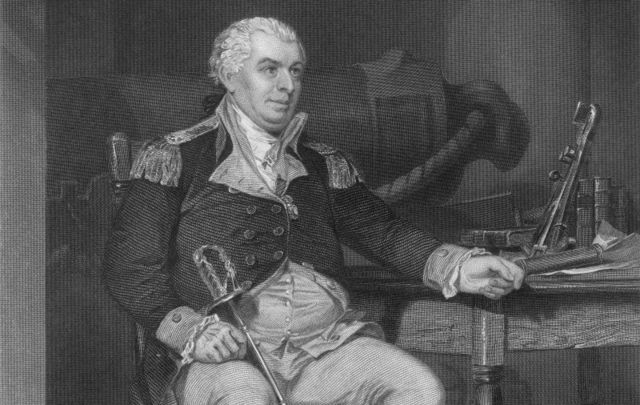
Wexford native Commodore John Barry, who was born on March 25, 1745, is known as the "Father of the American Navy," along with John Paul Jones and John Adams.
This is John Barry's incredible story.
On a fine spring day in 1787, John Rossiter’s merchantman, the Rising Sun, glided towards the Philadelphia waterfront after a successful voyage from County Wexford. The hold was full of Irish goods – flaxseed and linen – but Rossiter was happiest about the passengers standing on deck with him: Michael and Patrick Hayes, teenage orphans from Wexford, summoned by their uncle (and Rossiter’s good friend) to come live in Philadelphia.
The boys’ uncle was also a ship’s captain, who’d left Wexford 77 years earlier to make Philadelphia his home. As well-respected as Rossiter was, this mariner was a legend for both his seamanship and heroics in the recent war for independence from Great Britain. Rossiter searched for him among the small crowd at the dock. At 6’4”, he was easy to spot, standing with his wife, their faces anxiously gazing at the Rising Sun. Rossiter pointed him out to the boys.
No sooner was the gangplank lowered than they were swept into the arms of John and Sarah Barry, who were ten years married but childless. Barry’s nephews became the sons they never had and were the latest in a long slew of Irish immigrants who had found both shelter and guidance from the Barrys.
Irish in Philadelphia in the 1700s
For Irish Catholics in the 18th century, charity began at home out of necessity. James Barry was a tenant farmer, similar in hardship and poverty to the life of a sharecropper in the post-Civil War South.
When John was born in 1745, the Protestant Ascendancy – descendants of British colonists who made up the Irish Parliament – was beginning its second century of running Ireland under the draconian Penal Laws, banning Catholics from owning land, practicing their religion, even speaking their native Gaeilge.
In a few years, James and Ellen Barry had five mouths to feed and John, the oldest son, now about ten, was sent to sea, placed under the watchful eye of his uncle Nicholas, a ship’s captain who took advantage of a glitch in the Penal Laws: he could not own the goods in his hold, but he could own his ship. Nicholas Barry’s trade allowed him to work with his head held high, and the example he set for his nephew was as true as a compass. Each time he returned home, young John’s small wages were a godsend when he poured them on the family table.
For generations, Barry’s coming to Philadelphia was told as a Horatio Alger-like story of a happenstance arrival to the New World. In fact, he was sent there.
By 1760, there was such an established Irish presence in Philadelphia that one official, scornfully describing them as “bold and indigent strangers,” warned Quaker and Anglican alike that “It looks as if Ireland is to send all its inhabitants hither.”

Love Irish history? Share your favorite stories with other history buffs in the IrishCentral History Facebook group.
The first voyage - launching a career
Among them was Jane Barry Wilcox, an aunt or older cousin of John’s, whose husband was one of a small but growing list of Irish-born merchants. Whether young Barry stayed with Jane for just a few nights or used her home as a waystation in between voyages is not known, but over the next six years his ambition to equal his uncle was rewarded, as he rose from seaman to mate until, in 1766, he was given his first command, a schooner and a crew of five, making several voyages a year to Barbados.
A captain’s pay meant more money could be sent home. It also allowed him to marry a young Irish girl, Mary Cleary, and move into a small house near the Philadelphia waterfront (within the awful stink of the city tannery).
Over the next decade Barry, climbed the riggings of his profession, hired by a succession of increasingly affluent merchants, even owning his own ship at one point. He and Mary moved to more upscale housing and took in a servant.
He joined the prestigious Society for the Relief of Poor, Aged, and Infirmed Masters of Ships, and Their Widows and Children, better known as “the Sea Captains’ Club.”
As in other ports, Philadelphia’s mariners took care of their own, and their dues assured just that. But the club also provided Barry the opportunity to observe how to behave in the gentlemen’s dining room. While some members came from as rough and tumble a life as he, there were others, like Charles and Nicholas Biddle, equally at home on a merchantman’s deck and in a salon. With quiet intensity, Barry scrutinized their posture and language, right down to what fork went with what course.
It wasn’t long before Barry’s other brothers made their way across the Atlantic. Patrick was already an experienced mariner, while Thomas embarked on a quieter career as a clerk. When Mary died while John was at sea in February 1774, it was Patrick who was rowed out to his brother’s approaching vessel to break the news. Only 29, John Barry found himself a widower.
Resistance to British
All of this took place beneath darkening political clouds. Barry’s ascendance occurred during the troubling years when the American colonies’ relationship with the British crown and Parliament were fraying. The Stamp Act, the Townshend Acts, the Tea Act and the Intolerable Acts all met with resistance in the colonies, particularly in Boston and Philadelphia, whose merchants based their opposition on their rights as British citizens. Where their Quaker counterparts urged passivity, most Anglican merchants were vociferous in their opposition to any new taxes and duties. Their opinions were shared by Barry and other captains over pipes and punch bowls at the City Tavern. Resistance to British authority was easy for an Irish-born captain like Barry to support. When hostilities broke, John offered his services to the nascent Continental Navy, while Patrick served as a privateer. Sadly, Patrick’s ship was later lost at sea in 1778; three years later, Uncle Nicholas informed John that both his parents were also dead.
When hostilities broke, John offered his services to the nascent Continental Navy, while Patrick served as a privateer. Sadly, Patrick’s ship was later lost at sea in 1778; three years later, Uncle Nicholas informed John that both his parents were also dead.
The war slowed Irish immigration to America down to a trickle, and Barry’s homeward contributions became fewer, for while Barry served his country admirably (and was severely wounded), he went largely unpaid for his services. His new in-laws, however, more than made up for any slack in family intrigue.
In July 1777, Barry remarried. His bride, Sarah Austin, was nine years his junior, beautiful according to contemporary descriptions, and a stitch-sister of Betsy Ross; one of her flags flew atop John Paul Jones’ ship Ranger on her voyage to France. The year before, Sarah’s brother Isaac marched with Barry and other Philadelphians, following Washington’s Continentals to Trenton and Princeton, while William, the eldest of Sarah’s siblings, was more than willing to demonstrate his loyalty to the crown.
Love Irish history? Share your favorite stories with other history buffs in the IrishCentral History Facebook group.
Benedict Arnold and William
Upon capture of Philadelphia after the Battle of Brandywine, General Howe charged William to save the city from being burned by departing rebels. William became an officer in a Loyalist regiment, departing Philadelphia with the British Army for New York in 1778. He was immediately accused of treason by the Pennsylvania Assembly. The Austin family business and homes were seized, forcing Barry and Isaac into years of political maneuvering to recover the family fortune.
And William wasn’t through yet. In 1781, he commanded an eighteen-gun ship, participating in Benedict Arnold’s raids along the Chesapeake. From there, William sailed to Yorktown, where he was captured and placed on a prison ship bound for New York.
News of William’s misfortune reached Barry in Connecticut, where he was refitting his frigate, the Alliance. Knowing full well Washington’s hatred of Arnold, Barry wrote and later visited the general, asking him to intercede on William’s behalf – calling William his friend while tactfully omitting his involvement with the traitor of West Point. Washington, one of Barry’s staunch admirers, promised to look into the matter.
William spent the rest of his life in exile, living in Nova Scotia, London, and South Carolina over the next thirty years. Throughout that time, Sarah and Isaac had nothing to do with him, but Barry began a correspondence with him that lasted until Barry’s death.
His letters began, “My Dear Brother,” while William’s equally cordial letters were addressed “My Dear Barry.” From London, William sent him an “Axminster Carpet” and other furnishings; in one letter, Barry requested the latest books, including Tom Jones. Ever frugal, he instructed William to give them to the ship’s captain for delivery, sparing Barry any customs duties.
War’s end found Barry so broke that he was forced to write General Anthony Wayne, his partner in a cattle roundup that helped feed Washington’s army during the Valley Forge winter, to loan him $200. Wayne didn’t have the money either. Sad news arrived from home, from his brother-in-law Thomas Hayes; his wife Eleanor – Barry’s sister – was dead, and he was gravely ill. Barry’s other sister, Margaret Howlin, was also widowed, living in poverty. Hayes called Barry’s contributions their “only relief” and “praised God for having such a friend” in his later days; Barry assured him that he would “prove a real father” to Hayes’ children when the time came. Another letter soon followed, from Uncle Nicholas. The time had come.
Nicholas’ missive was delivered by “Mathew Doyle a lad of good repute” whom Nicholas was sure Barry would assist in finding proper employ, being “brought up to husbandry.” His arrival signaled the beginning of a steady stream of immigrants who made their way to Barry’s doorstep, seeking lodging, employment, and counsel. Barry always had an ample supply of each.
Building a navy and his fortune
Over the next three years, Barry joined other naval officers with memorials to Congress and the Pennsylvania Assembly, chasing down agents in France and Cuba for the money due him from captured prizes. The money came his way very slowly. But luck began turning his way in 1787, with an offer to command a merchantman bound for China. Barry was overseeing construction of the Asia when John Rossiter brought his nephews to Philadelphia. Both boys wanted to go to sea. Michael began a long association under Rossiter’s employ, while Patrick accompanied his uncle, sailing around the world with him to China.
Few journals of the time match Patrick’s wide-eyed recounting of the long, fascinating, and dangerous voyage to Canton. He captured everything with a boy’s vividness: storms, lightning strikes, the suicide of the despondent third mate, and their layover in Cape Town, where his marvel at the exotic animals of Africa is mixed with dread at innate racism, even in the dispensing of justice. Patrick found “3 gibbets one fore the sailors one for the soldiers and one fore the Slaves” – after all, one wouldn’t hang a white criminal on a black man’s gallows.
Bats with seven-foot wingspans and colorful snakes sailing alongside the Asia dotted his description of the tricky passage through the Sunda Straits. When they finally reached Canton, Barry kept Patrick by his side in hopes of keeping him out of the taverns and brothels, and he succeeded, it seems, until their departure. While in Macao, Patrick escaped his uncle’s supervision. His last entry in his journal merely reads, “Maddam: full of shame” – and we will never know why.
Barry returned home with his fortune remade, and actually swallowed the anchor over the next five years. With Sarah’s blessing, their estate, Strawberry Hill, became home for the Hayes brothers when back from their voyages. Patrick even fell in love with and married Sarah’s niece, Betsy Keen.
Now Barry’s correspondence with family and friends flourished, as did his willingness to help those in need. A regular stipend was sent to his sister Margaret. As perfect strangers showed up at Strawberry Hill, carrying letters of introduction from this relative or that acquaintance, Barry found himself a one-man employment service, finding work for craftsmen at shipyards and positions for clerks in counting houses. Young sailors always won a berth if they carried a recommendation from John Barry. When the city was decimated by the first in a series of yellow fever epidemics in 1793, Barry’s letters of recommendation about a young Mr. Shannon’s “integrity and sobriety” landed him a position at the Bank of the United States, while another started working for another successful Irishman, the printer Matthew Carey.
Not all of Barry’s charges lived up to his standards. When another “John Barry” asked assistance in getting a berth on “a Ship bound to the East,” Barry immediately interceded, securing him a second mate’s position on an Indiaman bound for “Maddras or Calcutta.” The grateful sailor left Philadelphia with a full hold, leaving a pregnant wife. Months later, Barry learned the man’s talents belied his name; for his wretched performance to his duties he “was left behind at Bengal,” abandoning his wife and baby. “I understand she goes out nursing,” Barry sadly told a mutual acquaintance.
Philadelphians also knew where to send any unwanted Irish castaways. When a young lass arrived to serve an indenture to a rich wastrel of such low character that she wanted to run away, the pompous buffoon sent her to Barry’s door.
That said, Barry was first and foremost an American. When an old acquaintance from Wexford wrote him about buying land in the Mohawk Valley, Barry all but ordered him to Philadelphia:
I am much at a loss to know whether you have a family or not and what your views can be for a man of your years to bear yourself in the woods unacquainted I presume with cutting down trees or building log houses far removed from any place to educate your children if you have any… If you can make convenient to spend a few weeks with me at Strawberry Hill within three miles of Philadelphia you cannot refuse my request as you would have a good dale of time on your hands this winter.
After another Irish friend looked to return to the old sod after a lifetime in the West Indies, Barry was genuinely perplexed; after all, he believed “There is everything the heart could ask for here.”
When President Washington appointed Barry first among captains of the new United States Navy – created ostensibly to protect American shipping from the Barbary pirates – Barry was justifiably proud, anxious to live up to his old friend’s expectations. It was thought the new navy’s ships would be built in months. They took years. By the time they sailed into combat in 1797 it was against a different enemy, French privateers in the Caribbean. Beset by chronic asthma and gout, Barry was no longer the hero of the hour. Past his prime and openly derided by President Adams and his staff, Barry was relegated to serving as “Mr. Chips” to the next generation of naval heroes: Stephen Decatur, Richard Somers, and Charles Stewart among them.
Nor was there smooth sailing at home. While Patrick’s career emulated his uncle’s successes as a merchant captain, Michael’s was tragically cut short. His ship was lost at sea on 1801. The Barrys, in particular Sarah, were heartsick. When the old Commodore, yearning for one more chance to restore his reputation as a fighting sailor, finally received an offer from President Jefferson to lead a squadron against the Barbary pirates, he was too ill to accept, “being on his last tack.” He died months later.
One of the last entreaties he received from Wexford came from a cousin, Nancy Merriman Kelly, born just days after his own birth so many years before. Her husband Michael, at 59, had joined the “Boys of Wexford” at New Ross on June 5, 1798, and was one of the first killed in three days of fighting against superior British forces. For years, Barry’s father had given her “half a Guinea” out of the money Barry sent home; could he send that to her, “Being in Such Need?”
Of course, he could; of course, he did.
* Originally published in 2011, updated in 2024.
Comments