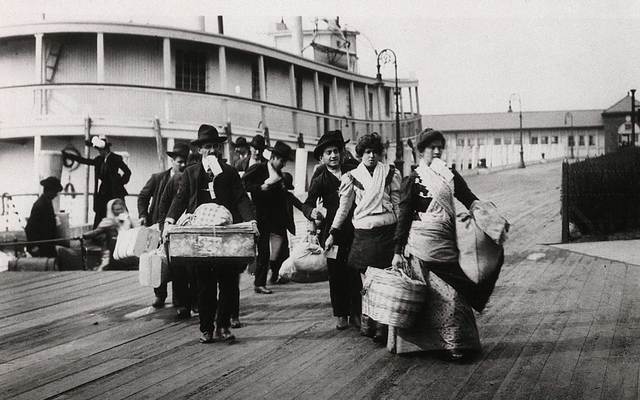
How much do we know of the fate of the Irish once they traveled to North America? We look at what has been written on their experience.
If you ever spend the day at the Silver Lake golf course on the north shore of Staten Island, New York, pay attention. It’s not that the greens are particularly speedy or that the course is unusually challenging. What you should keep your eye out for, instead, is a simple stone surrounded by flowers near the clubhouse. A plaque on the stone reads: “The Forgotten Burial Ground: Here lie the unmarked graves of Irish immigrants who fled the famine in search of freedom … They will not be forgotten.”
From 1849 – 1858, beneath what is now the golf course, a cemetery was created to bury immigrants who perished at a notorious quarantine hospital nearby, which was eventually torched and destroyed by nativists.
In fact, in 2009, former New York Archbishop Edward Cardinal Egan presided over a memorial mass in honor of Irish immigrants who died at the same hospital and were buried in other unmarked graves on Staten Island.
What was it like?
This regrettable slice of history sheds light on an easily forgotten aspect of immigration during the Great Hunger. Much time is spent debating why the Famine occurred, what could have been done to prevent it, and the ways it changed not only America but also Canada, Australia, England, and other nations.
Such big-picture questions make it easy to forget what the actual arrival of individual Irish immigrants – those who survived the treacherous journey to North America – was like. What did they experience once they’d crossed the Atlantic and entered the ports of Manhattan or Boston, Quebec or Brooklyn? What kind of entrance process was there – if any? What obstacles did they face when it came to health, housing, and jobs? Or, for that matter, personal safety? The docks, after all, were often rife with criminals who sought to exploit the desperate new arrivals.
The first illegals
One problem with attempting to understand a Famine immigrant’s first experiences in the U.S. is that there are relatively few first-hand accounts from the 1840s. Other traumatic historical horrors, such as the enslavement of African Americans or the Holocaust, are simply better documented.
We do, today, commemorate the immigrants who landed at Grosse Île, Canada, where typhus, dysentery, and cholera left thousands dead. In Peter Quinn’s landmark historical novel "The Banished Children of Eve," one character lands at Grosse Île after a five-week journey from Ireland that left 48 people dead, “one-fifth of those who sailed.”
An official in a blue jacket arrived and went about the entire ship poking into every corner. … He said that a boat would be sent to bring the sick to the island, where they would temporarily be held in quarantine, but that the bodies of the dead must be brought immediately…. The flies made a frenzied hum in the air…. [A] woman delirious with fever [was] praying and cursing in Irish.
Of course, not every crossing to North America was so deadly. The famous Jeanie Johnston ship crossed from Ireland to Quebec in relative safety over a dozen times. In addition, not every Irish immigrant who arrived in Canada stayed in Canada. Quite a few (such as the character Jack Mulcahey in "The Banished Children of Eve") went to the U.S., making them the first large wave of border-crossing illegal aliens. Indeed, whether they went from Canada to Boston or New York or Chicago (a city that only began to grow in the 1840s), the first thing many Famine immigrants did was move yet again, in search of work, shelter or, at the very least, stability.

Love Irish history? Share your favorite stories with other history buffs in the IrishCentral History Facebook group.
Melville, Thoreau, and the Irish
By now, we do know a fair amount about conditions aboard the “coffin ships” on which many immigrants traveled.
Books by Famine-era Irish writers such as Mary Anne Sadlier, Peter McCorry and Father Hugh Quigley often included scenes of the “crossing to America,” which is “seen as a wrenching rite of passage, the violence of which is often symbolized by a fierce storm at sea,” according to acclaimed Irish-American literary scholar Charles Fanning. In addition, some of the greatest American writers of the Famine era have explored the experiences of newly-arrived Irish immigrants.
In 1849, "Moby Dick" author Herman Melville wrote the short novel "Redburn," about a journey from Liverpool to New York. The ship’s passengers include the O’Briens and O’Regans. Redburn, however, is mainly about the journey of the young American at its center. Melville never follows the O’Briens or O’Regans once the ship docks. As is often the case with the Irish in 19th-century American literature, the immigrants in "Redburn" are peripheral, not to mention stereotypical. (“Pat, ye divil, hould still while I wash ye,” Mother O’Brien says at one point while washing her sons. “Ah! But it’s you, Teddy, you rogue. Arrah, now, Mike, ye spalpeen, don’t be mixing your legs up with Pat’s.”)
"Walden" author Henry David Thoreau, in his journals, also writes of recent Irish immigrants picking through the rubble of what was once the ship St. John. It had left Galway but sailed into a storm and broke apart a mile from Boston Harbor.
“All their plans and hopes burst like a bubble,” the horrified author writes. “Infants by the score dashed on the rocks by the enraged Atlantic Ocean. No! No!”
Thoreau’s tone changes later. He sneers at “ill-dressed, ill-mannered boys – of Irish extraction…a sad sight to behold,” ominously adding: “The opening of this valve for the safety of the city.”
But Thoreau also details the lives of hard-working Irish laborers, farmers, and a “washwoman,” eventually declaring: “The simple honesty of the Irish pleases me.” (It must be added that Thoreau says this after chatting with a drunken immigrant potato-digger.)
What we do know
The observations of these famous writers are interesting. Still, we are without an Irish equivalent to "Uncle Tom’s Cabin" or "The Diary of Anne Frank," an account that vividly outlines the common experiences of Famine immigrants during their arrival and traumatic first days in a strange new land.
So, what do we know about the first experiences of the Irish once they’d arrived in America?
Irish writer John McElgun explored this in his best-selling 19th-century novel "Annie Reilly: Or the Fortunes of an Irish Girl in New York." The book was recently excerpted in the invaluable new collection "Becoming Americans: Four Centuries of Immigrant Writing" (edited by Ilan Stavan, with a foreword by Pete Hamill).
McElgun writes about his title character’s immigrant companion James O’Rourke, who had a “comparatively safe and speedy passage,” and who later thinks: “How beautiful New York Harbor looked!” Since it is “early day, the passengers were not delayed at Castle Garden overnight,” and in a matter of a few paragraphs, James (who left Ireland a few years after the Famine) is gleefully walking the streets of Manhattan in search of employment.
This is certainly a more benign take than usual on an Irish immigrant’s arrival. In recent years, historical novelists, painter, and filmmakers have explored its more difficult aspects. In Kevin Baker’s epic 2002 novel "Paradise Alley," the characters Ruth and John disembark not in bustling Manhattan but on a desolate Staten Island beach, “covered with every manner of debris, natural and man-made.” Ruth passes out and wakes up in a hospital with a raging case of “ship’s fever,” but is abruptly booted out because “there’s two more ships already lined up in the Narrows.”
Such quarantine hospitals were common, from Staten Island to Partridge Island, near New Brunswick, Canada. This, in fact, is the subject of a vivid historical painting by Ray Butler, which depicts the shore filled with ailing Irish immigrants being tended to by Dr. George Harding, who is said to have cared for over 2,500 immigrants in a single day.
Meanwhile, though it is set in the years after the Famine, Martin Scorsese’s film "Gangs of New York" depicts immigrants disembarking while nativists pelt them with rocks. This would ring true to immigrants who arrived in 1840s Philadelphia or Boston, hotbeds of nativism where new arrivals would have heard about riots or arson initiated by members of the fledgling, anti-immigrant, anti-Catholic Know Nothing Party.
Despite such hostile greetings, many Famine immigrants, such as those to Cleveland or New Orleans, did not venture far from the sea that bore them to America. A shanty village known as Irishtown Bend formed along the banks of the Cuyahoga River, while in the riverfront town of Lafayette, near New Orleans, parishioners of St. Alphonsus faced an outbreak of yellow fever, which killed an estimated 20 percent of the area’s Irish immigrants.
Outbreaks of cholera, yellow fever and malaria were also common in New York City. This was partly due to the trash that piled up in the streets. Close to 200,000 horses used for transportation contributed to the mess. Sewers weren’t created until the 1850s.
Absence of authorities
The horrors of Lafayette and the more benign Manhattan of McElgun’s Annie Reilly have one thing in common: the generally low presence of bureaucratic authorities regulating Irish immigration.
Annie Moore may be fixed in the American consciousness as the quintessential Irish immigrant, the first lassie to land at Ellis Island. But that was 60 years after the Famine. Even the famous Castle Garden mentioned by McElgun did not become a processing station until 1855, a decade after the famine began. Local police, medical authorities or (often ruthless) representatives from the shipping company might have been on hand as the Irish disembarked, maintaining order or pointing the way to quarantine hospitals. But generally speaking, the Famine immigrant experience is unique in that the Irish – for better or worse – were entering a nation with only a patchwork system for processing newcomers.
Preying upon the vulnerable
What this means, of course, was that the Famine immigrants were vulnerable. In the aforementioned Annie Reilly by John McElgun, we learn that Irish immigrants were preyed upon at the docks by so-called “runners” or “man-catchers.” James, for example, is swindled by a man who claims he can locate employment – for a price. Some runners might affect a good Irish accent, or even speak Gaelic. On the other hand, there was only so much damage the runners could do. Irish immigrants generally carried very little with them, often having sold valuable possessions back in Ireland. Finally, newly arrived Irish during the Famine often sought out church and political officials. Both offered shelter, food, and guidance, asking only for an immigrant’s soul and vote in return. New York’s Archbishop John Hughes swiftly saw that American officials were not going to care for the Irish, so he set about creating a Catholic nation within a nation, providing education and healthcare. Political machines, meanwhile, gave the Irish a way to fight the nativists at the ballot box – or, if necessary, on the street corner.
So, having survived the traumatic journey, the nativists and scam artists, there is one more thing the Irish developed in the U.S. – a concern for the land they had left behind. This devotion to Ireland would infuse many of the institutions the Irish would come to dominate in the decades which followed the famine – the Catholic Church, City Hall, big-city fire and police departments.
Having risen from the docks to Wall Street, the Irish began building a bridge across the Atlantic. This monumental project is still underway, though its origins stretch back 150 years, to traumatic voyages across the sea, and subsequent simple questions such as the one James O’Rourke is asked by a fellow Irishman in John McElgun’s novel: “How is things [in Ireland] now; any better? … [T]he people an’t [sic] starving as they wor [sic] when I left there?”
*Originally published in 2010, updated in 2022.
Love Irish history? Share your favorite stories with other history buffs in the IrishCentral History Facebook group.


Comments