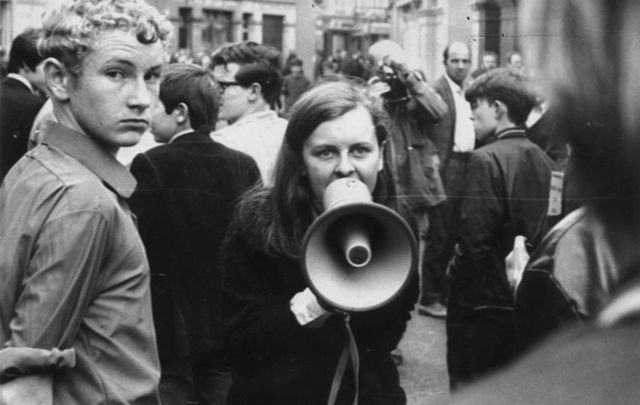
Half a century ago, 1969 marked one crazy year for the Irish and Irish Americans. From Belfast to the Bronx, from Beckett winning the Nobel Prize to Breslin's failed run for office, Tom Deignan unpacks it all.
It is fitting that the 1969 Nobel Prize for literature went to the Irish playwright and novelist Samuel Beckett. After all, in works such as "Waiting for Godot" and "Endgame," Beckett alternated between tragedy and comedy, drama and farce.
The same could be said about 1969.
It has now been 50 years since that eventful year, which gave us Woodstock, the moon landing, the Manson family, and revelations about a massacre in a Vietnamese village called My Lai.
But 1969 was also a decisive year in Irish-American history. That year, it seemed as if Irish Americans in Chicago and New York, California, and Philadelphia were fighting their own civil war. The causes of the conflict were religious, generational, and geographic. Whatever the cause, these conflicts made for a rather chaotic year.
Troubles in Belfast and the Bronx
Most importantly, the Troubles in Northern Ireland reached a boiling point in August of 1969, with the clashes that came to be known as the Battle of the Bogside. Support for Catholic civil rights in Northern Ireland was initially strong in America. However, a new generation of Northern Ireland activists then toured America, challenging Irish-American Catholics to examine closely the situation in their own homeland.
Similarly, in 1969, when legendary New York journalist Jimmy Breslin served as fellow author Norman Mailer’s running mate in the race to be New York’s mayor, many assumed the semi-comical run could get some serious attention. It was believed that Mailer would appeal to the intellectual elite while Breslin would win the votes of Irish Americans and other ethnic Catholics.
That thinking went out the window, however, when Breslin was greeted with derision in, of all places, the Bronx’s Gaelic Park.
Also in 1969, the great Irish-American political clan – the Kennedys – remained in the spotlight just one year after Bobby was gunned down. In July, a strange new word –“Chappaquiddick” – was suddenly on everyone’s lips, especially those who looked to sink the once-promising career of Ted Kennedy. A few months later, Ted’s father, Joe Kennedy Sr., passed away at the age of 81.
And that was not the only loss Irish America suffered that fateful year. An aspiring author with the all-too-fitting name of John Kennedy Toole killed himself in March.
Toole’s mother made it her mission to turn her son’s grimy manuscript, about an Irish New Orleans misfit named Ignatius J. Reilly, into a published novel. That novel, of course, was A Confederacy of Dunces, for which Toole was posthumously awarded the Pulitzer Prize for fiction in 1980.
John Wayne and McSorley’s
True, 1969 wasn’t all about death and conflict.
Famed actor John Wayne (born Marion Morrison) spent his career making classic films with fellow Irish American John Ford, among them The Quiet Man. In 1969, Wayne finally won a Best Actor Academy Award for his role in True Grit.
But mostly, 1969 was the year Irish America faced disorienting change. If events in Northern Ireland didn’t make that clear, then events at a humble pub with sawdust-covered floors, on East Seventh Street in Manhattan, did.
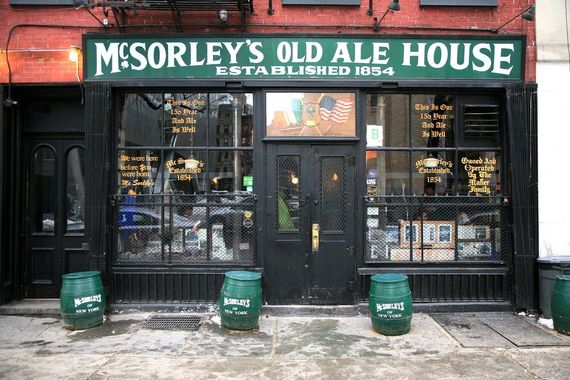

McSorley's Old Ale House in the East Village
It was in 1969 that a group of women challenged the century-old policy of allowing only men into what is often described as America’s oldest Irish pub, McSorley’s Old Ale House.
What a year. Even Samuel Beckett could not have made this stuff up.
By far, the biggest news in Irish America was the explosion of violence in Northern Ireland in 1969. The hot summer turned bloody in mid-August during the annual Apprentice Boys march in Derry, which was seen as a celebration of Protestant domination. Catholics and Protestants clashed, and when the Royal Ulster Constabulary intervened, the infamous Battle of the Bogside ensued.
The battle was just one episode during the year that spurred nationalist Catholics to organize and fight for their status as second-class citizens.
Not surprisingly, Irish America mobilized behind the North’s Catholic civil rights movement.
Bernadette Devlin tours America
Irish America had always played an integral role in the fight for justice in Ireland. And so, just as John Devoy and Eamon de Valera did in the past, a new generation of Irish nationalists toured the U.S. to drum up support for their cause.
But 1969 was different. That became clear when 22-year-old Bernadette Devlin came to the U.S. in August.
The telegenic firebrand – the youngest person ever elected to British Parliament – seemed ready to woo Irish America with her reports of Catholic oppression in Northern Ireland. But Devlin wanted to speak out against all injustice – including the ongoing segregation of African Americans in the U.S. Devlin criticized the likes of Chicago Mayor Richard Daley, the Ancient Order of Hibernians, and even the Catholic Church.
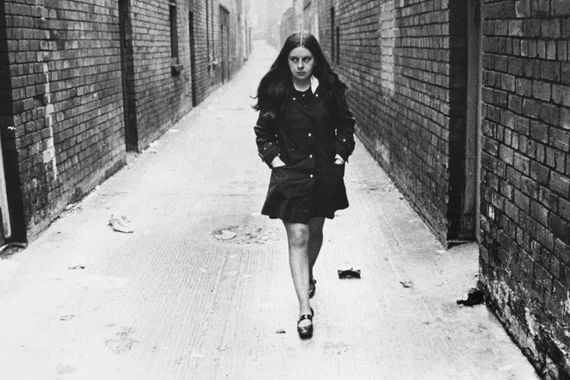
Bernadette Devlin in Belfast, 1969. Photo: Getty Images
Devlin argued that Daley and many other Irish-American power brokers either ignored or contributed to social inequality in the U.S. Perhaps most shockingly, she compared many Irish-American leaders to the Orangemen in Northern Ireland who repressed Catholics.
To put it mildly, traditional Irish Americans did not take this well. The AOH, which had raised money for Devlin, swiftly took back the gift, handing it instead to the Irish Catholic Church.
This, however, did not change the fact that even on an issue that seemed simple – supporting Catholic rights in the North – Irish America was being challenged in ways it never had been before.
Breslin’s unlikely run
The same dynamic – traditional Irish Catholics disturbed by the more radical nature of younger Irish Catholics – was on display in New York City.
Author Norman Mailer decided to run for mayor. His running mate, hoping to become City Council president, was Jimmy Breslin, already a legendary newspaperman. Perhaps most famously, six years earlier, when John F. Kennedy was killed, Breslin wrote a famous column profiling the humble laborer who dug the first Irish Catholic president’s grave.
If Irish America grieved in unison in 1963, those days were gone in 1969. Breslin, though from a humble, broken home in Queens, began to be seen by some blue-collar Irish as just another egghead intellectual who sided with long-haired college kids and Vietnam protesters.
So, when Breslin showed up at the Bronx’s Gaelic Park one Sunday for a campaign stop, good feelings were hard to come by. Breslin was shouted at and threatened. When he left, he discovered that one of the tires on his car had been slashed.
“They are my people and they are waiting for me,” Breslin later wrote. “They are waiting to beat the hell out of me.”
As with the split over Bernadette Devlin, it appeared that there were two Irish Americans in 1969 – one traditional and satisfied with the status quo, the other progressive and seeking reform. Neither was willing to change. The very idea that one or the other should budge seemed only to harden their stances.
A divisive figure
Another divisive political figure in Irish America was Ted Kennedy. Many felt sympathy for the young brother of the slain president and aspiring senator. They believed Ted was the heir apparent to the kind of noble progressivism JFK and RFK embodied.
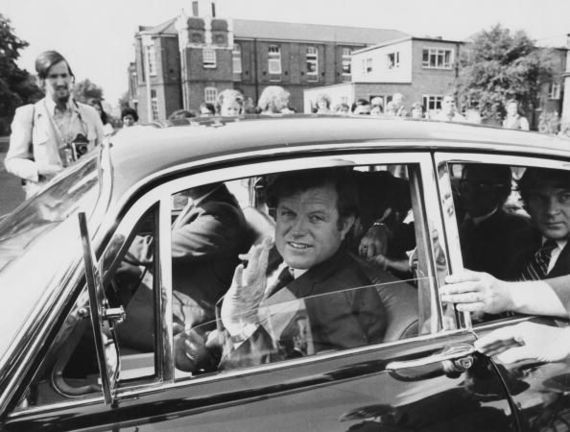
Ted Kennedy. Houlton Archive/Getty Images
For some, that changed following the events of July 18, 1969. Kennedy was attending a party on Massachusetts’ Chappaquiddick Island. After leaving, he lost control of his car and drove off a bridge. It turned out Kennedy had a passenger, a young woman who had worked for RFK's presidential campaign named Mary Jo Kopechne. Kennedy survived the crash. Kopechne did not.
Kennedy did not report the incident to the police until the next day. In his memoir True Compass, completed right before his death, Kennedy called his behavior “inexcusable.”
Then, on November 18 – four months after Chappaquiddick – Joseph Kennedy Sr. died at the age of 81. He suffered a stroke in 1961 and had been partially paralyzed since. Some wondered if the very public events surrounding Chappaquiddick hastened Joe Sr.’s death. Either way, for Irish America, it was clearly the end of an era.
A new era?
But if a new era was beginning, what would it consist of? Sure, everyone used the term Fighting Irish. But that seemed far too literal in 1969. It seemed as if the Irish – like much of America – was split into two warring camps.
One camp was represented by agents of change such as Bernadette Devlin. The other was described by unapologetic conservative John Wayne, who finally won an Oscar in 1969 for True Grit. Wayne was an outspoken critic of what he saw as the radical turn many Americans were taking. Many Irish Americans agreed wholeheartedly with Wayne.
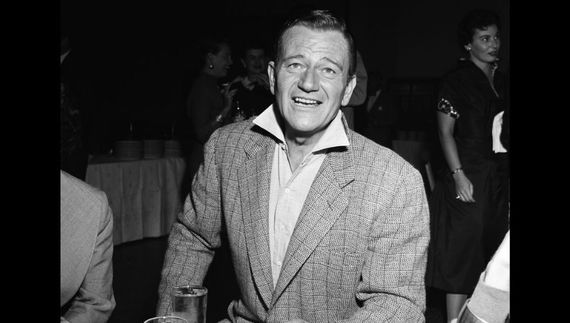
John Wayne.
But if Irish America bent severely in 1969, it never quite broke.
True, divisions remained. In his book, An American Requiem, the writer James Carroll (ordained a priest in 1969) eloquently explored many of the issues that divided Irish Catholic Americans through the 1970s.
Following Bernadette Devlin’s notorious tour of the U.S. in 1969, some activists abhorred the IRA while others funneled guns and cash to the nationalist cause. Ultimately, however, the so-called Four Horsemen of Irish-American politics – Ted Kennedy, Hugh Carey, Tip O’Neill, and Daniel Patrick Moynihan – forged a consensus that would eventually help the U.S. play a significant role in bringing peace to the North.
Finally, 1969 saw another significant development. For the first time in over four decades, Notre Dame’s Fighting Irish football team played a postseason bowl game. Since the 1930s, the school had decided not to participate in bowl games, despite their growing prominence and popularity.
Notre Dame finally changed its policy in 1969, pleasing the Irish’s many fans across the U.S.
The fifth-ranked Fighting Irish took on # 1 Texas in the Cotton Bowl following the 1969 season. The Irish lost 21-17.
That may seem fitting, given the way 1969 played out in Irish America. But it also meant that the Irish – the football team and the millions of Americans who traced their roots to Ireland – were back.
Fighting? Maybe. But still a force to be reckoned with.
* Originally published in 2009, updated in Nov 2025.
Comments